What Neuroscience Says Happens in Your Brain When You Pray
PrayerGroup.Live · · 7 min read
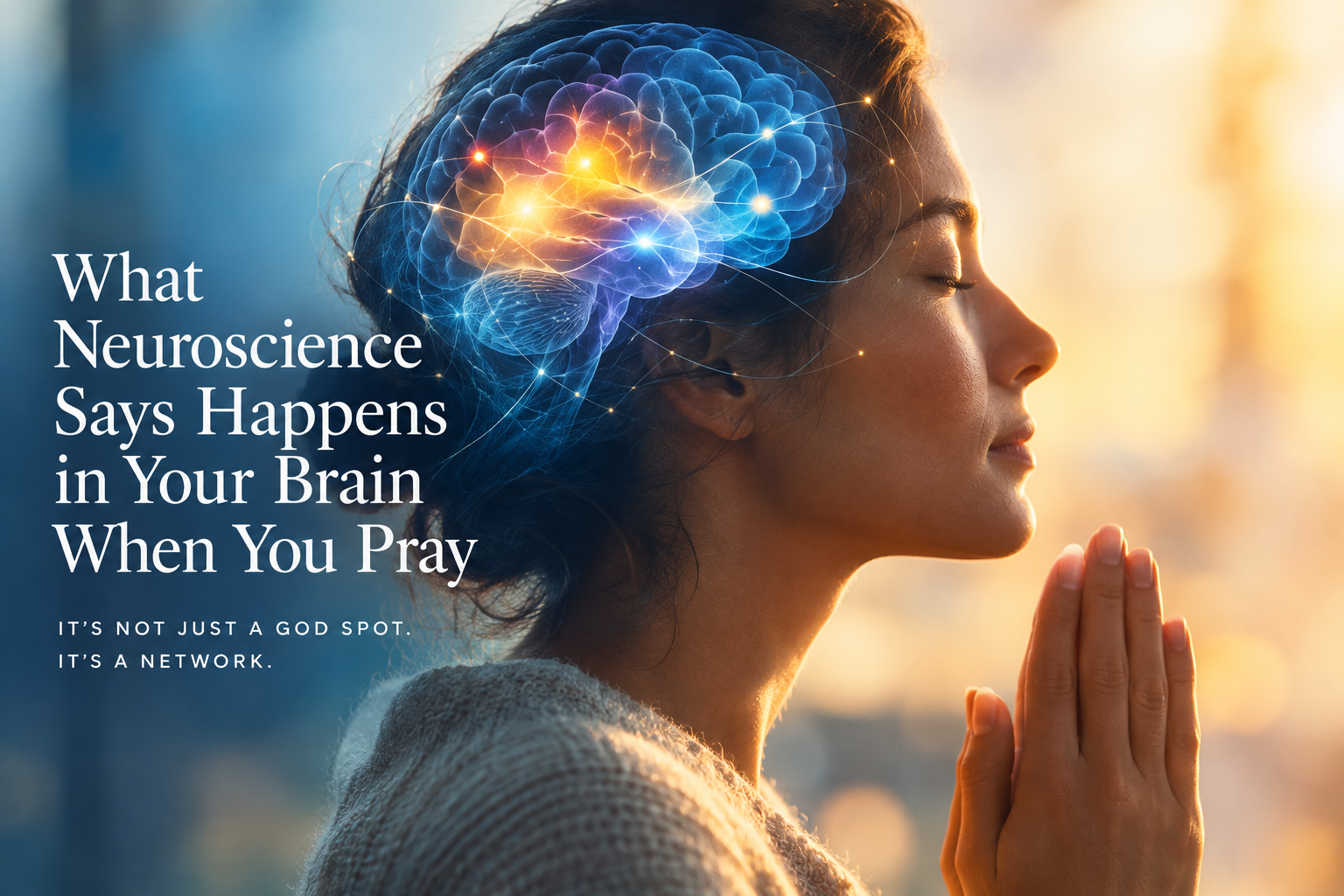
A Prayer Inside the Machine
In a dim room at the University of Pennsylvania, a woman who has prayed for most of her adult life settles into a chair, closes her eyes, and begins the slow, repetitive work of centering prayer. When she reaches the part she would describe as being in God’s presence, she signals the researchers. A tracer goes into the line in her arm, and minutes later a camera maps where her blood was flowing at the exact moment she felt most absorbed. That is roughly how Andrew Newberg described his early studies of Franciscan nuns to Salon, and it remains one of the stranger images in modern science: the most private act a person can perform, rendered as a heat map.
The field that grew out of experiments like this is sometimes called neurotheology, and its central question sounds disarmingly simple. What is your brain actually doing when you pray? About 20 years of scans later, the answer is more interesting than the old “God spot” headlines promised, and also more modest. Prayer, it turns out, is not one thing in the brain. It looks different depending on whether you are repeating a phrase, pouring your heart out, listening to someone else, or simply breathing in rhythm with an old set of words.
Where the Self Goes Quiet
Newberg, a physician who now leads research at the Marcus Institute of Integrative Health, started with two groups chosen because they could reach deep contemplative states on cue: Tibetan Buddhist meditators and Franciscan nuns. Using SPECT imaging, which captures a snapshot of blood flow at the moment a tracer is injected, his team found that both groups showed rising activity in the frontal lobes, the brain’s attention center, and a marked drop in the parietal lobes, a region that helps us locate ourselves in time and space.
The parietal lobe is part of how the brain draws the line between you and everything else. Quiet it down, the theory goes, and that line blurs. Both the monks and the nuns described their peak moments as a loosening of the self, an oceanic sense of unity, though they gave that unity very different names. On his own site, Newberg notes one telling difference: the nuns also showed increased activity in a language area of the parietal lobe, which makes sense for a practice built on words rather than visualization.
The pattern was not exclusive to Catholics or Buddhists. Speaking to NPR in 2009, Newberg said he saw the same parietal quieting in Sikhs chanting.
Talking to Someone Who Isn’t in the Room
Not all prayer is a dissolving. A lot of it, for a lot of people, is closer to a phone call: rambling, specific, occasionally a little desperate. In 2009 a team at Aarhus University in Denmark led by Uffe Schjødt put 20 devout Danish Christians into an fMRI scanner and asked them to do several things, including recite the Lord’s Prayer and pray in their own improvised words. The results, published in Social Cognitive and Affective Neuroscience, were striking in their ordinariness.
When people prayed personally, the regions that lit up were the classic “theory of mind” areas, the parts of the brain we use to model other people’s thoughts and intentions. In plain terms, the brain treated improvised prayer much the way it treats a conversation with a friend. The authors argued that, for believers, praying is an intersubjective experience comparable to ordinary interaction between people. The memorized prayer, by contrast, did not produce that same conversational pattern.
Schjødt’s group followed up with a study that is a little more unsettling. They played recorded prayers to Pentecostal Christians and told them some came from a non-Christian, some from an ordinary Christian, and some from a known healer. Reporting on the study in New Scientist described how, when listeners believed the speaker was a healer, areas tied to vigilance and skepticism became less active (study DOI). Trust, it seems, changes how closely the brain checks what it hears.
Warmth, Reward, and Six Breaths a Minute
If prayer can feel like a conversation, it can also feel good, physically good, in a way that people across traditions describe as warmth, peace, or a swelling in the chest. In 2016 neuroradiologist Jeff Anderson and colleagues at the University of Utah scanned 19 young adult members of the Church of Jesus Christ of Latter-day Saints while they read scripture, listened to quotations, and watched devotional videos. Participants pressed a button when they were “feeling the Spirit.” According to the university’s summary of the study, those peak moments were reliably linked to activation in the nucleus accumbens, a core part of the brain’s reward circuitry, along with regions tied to focused attention and to moral judgment.
The nucleus accumbens is the same region that responds to music, love, and, less poetically, gambling and drugs, a comparison that ScienceDaily and plenty of headline writers could not resist. A more generous reading is that the brain does not keep a separate filing cabinet for the sacred. It uses the same machinery for meaning that it uses for everything else that matters to us.
Then there is the body below the neck. In 2001 a group led by Luciano Bernardi in Italy asked 23 healthy adults to recite the Ave Maria in Latin, the core of the rosary, and separately a yoga mantra. The study in the BMJ found that both practices slowed breathing to almost exactly six breaths a minute, a rhythm that happens to line up with the body’s own natural cardiovascular oscillations. Heart rate variability and baroreflex sensitivity, both markers of a resilient cardiovascular system, rose.
It is a lovely detail: two traditions, centuries and continents apart, landing on the same cadence. Whether that is coincidence, cultural refinement over generations, or something else is the kind of question a scanner cannot answer.
What the Scans Can’t Tell Us
The deeper researchers go, the less the old idea of a single “God spot” holds up. In 2022 Michael Ferguson and colleagues at Brigham and Women’s Hospital analyzed brain lesions in two groups of patients, 88 and 105 people, and asked how damage in different places changed self-reported spirituality. As the Biological Psychiatry abstract explains, the lesions pointed to a circuit centered on the periaqueductal gray, a deep, ancient brainstem region also involved in fear, pain modulation, and altruistic behavior. The journal’s editor took care to stress that the findings do not imply that spirituality in healthy people is in any way abnormal.
The Part That Stays Private
What neuroscience offers, in the end, is less an explanation of prayer than a portrait of it. Prayer quiets the part of you that keeps track of where you end. It wakes the part of you that imagines another mind. It slows your breath to the pace your heart seems to prefer, and it lights up the circuits you use for everything you love. None of that settles whether anyone is on the other end of the line.
Maybe that is the most interesting finding of all: that the brain meets prayer with the same tools it brings to friendship, music, and grief. Which raises questions the scanner leaves to us. If your brain treats prayer like a conversation, who do you find yourself talking to? And if the benefits come partly from rhythm and attention, does the meaning matter, or is the meaning the whole point?
We all need a boost now and then. AI assisted us with this piece.